Coding for kids is teaching a child to give a computer instructions it can follow, in an order it can follow them, and then to fix the instructions when the computer does something unexpected. That is the whole thing. The languages, the robots, the games and the apps are just different places to practice it. Parents ask me when a child should start and which language comes first, and after teaching kids, leading schools for a decade and now running coding classes for 2,500+ kids across the Portland metro, my answer is the same every time: start earlier than you think, with less technology than you think, and in a very specific order.
What coding for kids actually teaches
When people picture "coding," they picture typing. For kids under 10, typing is the least important part. What a young child is learning when she codes is four habits, and every one of them transfers to school, to friendships and to the rest of her life.
Sequencing. Instructions have to happen in order. Move forward, then turn, then move again. A 6-year-old who has to arrange five command tiles to get a robot across the table is learning that order matters in a way no worksheet can teach.
Precision. A computer does exactly what it is told. There is no "you know what I meant." Kids find this hilarious and infuriating in equal measure, and it is one of the most useful lessons a child can learn about communication.
Debugging. The program did not do what she expected. Now what? The best coding classes treat this moment as the lesson, not the failure. Our instructors are trained to coach the fix rather than make it, because a kid who learns to look calmly at what went wrong has learned something that will outlast any programming language.
Decomposition. Big problems get broken into small ones. Make the character jump. Then make it jump when a key is pressed. Then make it land. Kids who learn to decompose problems at 8 become the 14-year-olds who can start a long essay without panicking.
When should kids start coding?
Around age 5 or 6, and without a screen. That surprises parents, so let me explain the order we use in our programs, because the order is the answer.
| Age | What coding looks like | Tools |
|---|---|---|
| 5 to 7 | Screen-free: physical command tiles and simple robots that follow a sequence | Coding tiles, button-programmed robots, LEGO engineering alongside |
| 7 to 10 | Block-based coding: drag-and-drop commands that snap together | Scratch, Minecraft Education, block code for robots |
| 9 to 11 | Game logic: variables, loops, conditions, inside games kids design themselves | Scratch, Minecraft Education, mBot2 robots |
| 10 to 12 | Text-based programming and app building on a real device | Kid-friendly Python, app-building tools |
The reason for this order is not that young kids cannot handle screens. It is that the concept has to come before the syntax. A 6-year-old who has physically laid down "forward, forward, turn, forward" and watched a robot get it wrong understands sequencing in her body. When she meets the same idea as a block on a screen at 8, it is already hers. When she meets it as a line of Python at 11, she is translating something she knows, not learning something new.
Why blocks come before Python
Every year a parent asks me why we do not just start kids in Python, because that is what real programmers use. Here is the honest answer from someone who has watched hundreds of kids learn to code. Text-based languages punish typos. A missing colon or a misspelled word stops the program cold, and a 7-year-old cannot tell the difference between "my idea was wrong" and "I typed it wrong." That distinction is everything. Block-based languages like Scratch remove the typing problem entirely, so when the program fails, the kid knows it failed because of the logic. That is the only kind of failure worth learning from at that age.
Blocks are not baby coding. The same concepts live in both: loops, conditions, variables, events. In our grades 2 to 5 classes, kids move from blocks to game logic to text-based programming across the terms, and the move to text happens when the ideas are already solid. Our App Builders tier for grades 4 to 6 has kids designing, building and testing an app that runs on a real device, with variables, logic and a user interface they chose. Nobody in that room is confused by a semicolon, because nobody in that room is learning what a loop is at the same time.
What a coding class should look like
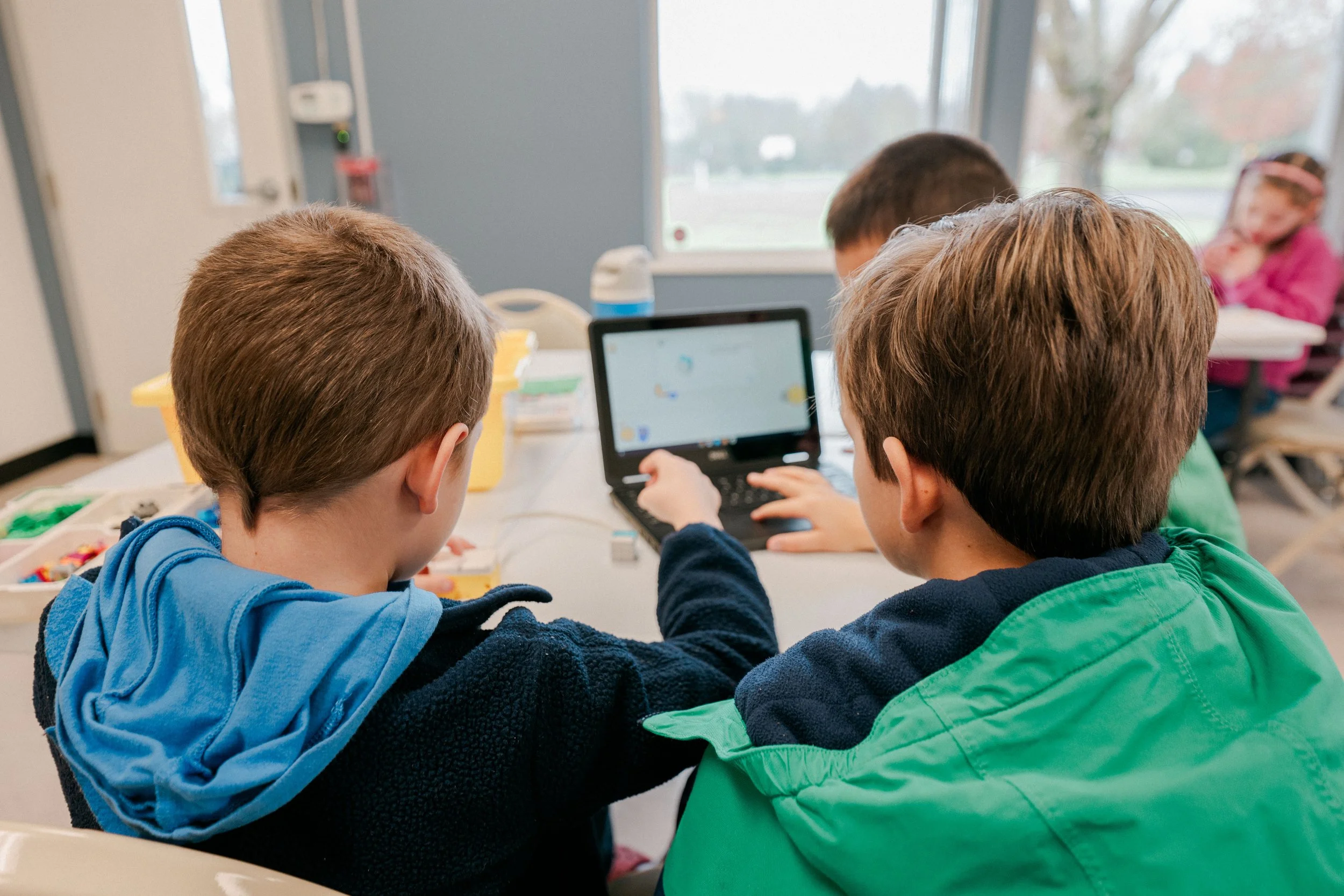
If you are evaluating a coding class for your child, here is what I would look for, in five parts. A short mission at the start, not a lecture: kids who just sat through a school day need their hands on something in the first ten minutes. A project that is theirs: no two games in our rooms look alike, because kids make design choices and defend them. Building alongside the screen: in our classes coding is always paired with a physical robot or a presentation, and the youngest kids have no screen at all. Small groups: our grades 2 to 5 classes are sized to our set of Chromebooks so every kid has a device, and groups are kept small and grouped by age. And a showcase: every term ends with kids demonstrating what they built, out loud, to families.
The last one matters more than parents expect. A kid who can explain her code to a room of adults owns it in a way a kid who just finished a level does not.
What about screen time?
A fair question, and one I take seriously as a parent. In our coding and robotics classes, Chromebooks are used for part of each session, always paired with building, testing and presenting. LEGO engineering and Preschool STEAM use no screens at all. The distinction I draw for my own kids is between consuming on a screen and making on one. An hour spent building a game that a classmate then playtests is not the same hour as an hour of videos, and I do not count them the same way.
How to support coding at home
You do not need to buy anything. The free version of Scratch from MIT runs in any browser and uses the same block logic we teach in class. More useful than any tool is the question you ask when your child shows you something: skip "is it done" and ask "what happens if you change that number?" or "why did it do that?" Those questions rehearse the exact thinking the class is building, and they cost nothing.
Frequently asked questions
What is coding for kids?
Teaching a child to give a computer or robot instructions it can follow, in order, and to fix the instructions when the result is not what she expected. Kids learn sequencing, precision, debugging and breaking big problems into small ones.
What age should a child start coding?
Around 5 or 6, screen-free, with physical command tiles and simple robots. Block-based coding fits ages 7 to 10, and text-based programming fits ages 10 to 12.
Which coding language should kids learn first?
A block-based language like Scratch. Blocks remove typing errors so kids learn from logic mistakes, not typos. Text-based languages like Python come once the concepts are solid, usually around age 10.
Is Minecraft coding real coding?
Yes, when it is taught as coding. In Minecraft Education, kids write block code to make things happen in a world they already love, and the concepts (loops, conditions, variables) are the same ones in any language.
How much screen time is in a coding class?
In our classes, Chromebooks are used for part of each one-hour session, always paired with building, testing and presenting a physical project. Our youngest programs have no screens.
How much do coding classes cost?
$299 per eight-week after-school term, plus the enrops service fee at checkout, or $720 for the full year of three terms. Need-based scholarships are available in every program.
Start with the tiles. The Python will come, and when it does, your kid will already know what it means.
With Grace and Gratitude,
Dr. Arielle Hammond, Ed.D.
Ready for the next step?
Dr. Arielle Hammond, Ed.D. is a former school principal and the founder of Journey to STEAM, the Portland metro's principal-founded STEAM enrichment program: LEGO engineering, robotics and coding for ages 3 to 12 at 75+ schools and community sites across four counties. Teach For America alum, principal at 24, Ed.D. from Lewis & Clark. More about Arielle and the team.
